Coaching philosophy (from the point of view of a young coach)
Introduction
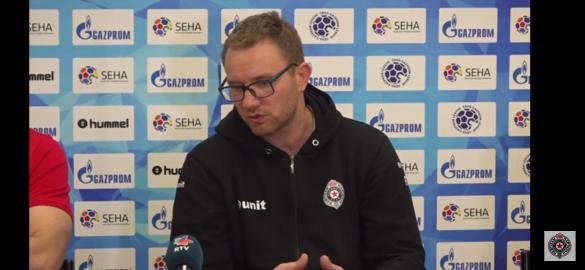
I would like to thank the admin of the website www.handballcoaching.gr for the invitation and the opportunity to express some of my views as a young coach about our profession, as well as to greet all the people who love handball. I am Petar Zujovic, currently the assistant coach of the handball club Partizan from Belgrade, as well as a member of the professional staff of the Youth national team of Serbia. Thinking about which topic I would choose, the suggestion of the admin was to speak in a more informal language and try to express my thoughts.
“A top coach must have a feeling, a feeling for the game, to recognize the momentum“.
A. The Feeling
Having participated in many seminars, listened a lot of big names from top level handball, no one ever said that there is an ideal tactic. It was always said, that a top coach must have a feeling, a feeling for the game, to recognize the momentum. I wondered if it was by luck, experience or maybe something completely third…
Then, working with mostly young players, I came to what best characterizes that feeling: it is getting to know the psycho-physical characteristics of your players on which you base your tactics, the defensive and offensive play. And the better you get to know your players, the better you determine tactics and the game philosophy you want to implement. And then, u reach to that momentum and that feeling that someone will notice u as a good coach.

B. Today’s Handball
In today’s handball, we all notice that the pivotman’s game has changed a lot and we cite the example of the French representative Fabregas as a prototype of a modern pivotman. Every coach tries to copy the game of the French national team and strives for that, but what if we do not have players with the characteristics of Fabregas in the team? Someone tries to play like the Danish national team in the attack, watches every action and tries to follow their game trend? Is that smart? I think no. All coaches fall into the trap of platitudes “fast handball”, “spanish system”, “French defense”, etc., without thinking about the characteristics of their players. How can we play fast like Denmark if we don’t have trained players from the youngest categories to play like that? How can we play a shallow 6-0 if we don’t have the dimensions and physical predispositions of the French national team members in the team? How can we do isolation for the right back, if we don’t have Gidsel in that position?
C. My Point of View
So from my point of view, coaches should first scan and check the individual characteristics of their players and what they have at their disposal, and only then determin the tactics and style of play in the attack.
Another example is the big debate about the defense; is a shallow or a deep 6-0 defense better? Are we going to turn it into another zone during the play etc.. And there is the main answer: the training of your players is the most important. They must be trained to recognize whether they are being attacked by a shooter or a feinter, a fast or slow player, a tall or a short one. Moreover, in the analysis of the opponent, the coach should recognize whether the opposite team is potent in terms of tactics, shooter team, whether it is feint (fast), etc., and based on that, determine the defensive zone the team should play.
Maybe my thinking seems simple, but my deep conviction is that sport should be understood in the simplest way as a GAME, as finding the simplest solutions in various situations. Complicating the game is a factor that will distance the player from the coach. The player should be offered the simplest solution and when he concretely sees that the result is good, accept you as a coach and your philosophy and style of play more quickly.

“Complicating the game is a factor that will distance the player from the coach”.

Conclusion
In summary, I would also like to mention the faith and consistency in what you do, as one of the more important factors in coaching. Our role is to encourage the player to go beyond their capabilities, respect the idea that we as coaches have, and this will only be done if we are consistent and believe in what we do. We should build and impose our authority with knowledge, as the most important factor, but also with a correct and fair attitude towards each individual in the team. Only in that case we can expect a positive feedback from our players.
In the above article I tried to analyze my personal thoughts regarding a subject that is particularly extensive. It is impossible to give answers and cover its full lenght in one page, however I am sure that this text can be a starting point for further reflection and discussion.
Petar Zujovic, Assistant coach handball club Partizan